
ModusSYSTEMS

Case study · Residential cleaning · Houston, TX

The cleaning companythat runs itself.

Client
Confidential · Houston home services
Industry
Residential cleaning
Stack
GoHighLevel · Quo · QuickBooks · Square
Running since
April 2026 — live today

The challenge

The owner was the only safety net.

This is one of the operating companies Modus runs its own systems inside — an active Houston cleaning company we use to battle-test the engine before we ship it to clients. Google Ads leads, repeat clients, cleaners in the field — the same stack most service businesses run. And the same leaks: after-hours leads waited on a human, follow-ups lived in memory, lapsed customers were never contacted again, and problems surfaced only by exploding.

Unpaid invoices, unconfirmed cleaners, complaints buried in threads — the only thing catching any of it was the owner, at midnight, re-reading conversations. That doesn’t scale, and it burns the owner down.

weekly CFO brief · monday 11:30 am · real
The actual weekly CFO brief the system emails every Monday, with figures redacted
The actual Monday brief from the live system — figures redacted, structure untouched.

The build

An operations layer, not a chatbot.

Speed-to-lead engine

Every new lead — form, text, missed call, any source — gets a personal text within seconds, 24/7, then multi-touch follow-up until they book or opt out.

Two-hour operations sweep

Every contact, conversation, and open job checked around the clock. Urgencies escalate, resolved items close, and the owner gets a short brief of the 3–10 things that need a human.

Lifecycle & winback engine

A daily scan of 300+ active relationships — dormancy, overdue invoices, at-risk signals — with re-engagement that runs inside owner-set guardrails: cooldowns, complaint holds, quiet hours.

Weekly AI financial analyst

QuickBooks, Square, and job data cross-referenced every Monday into a CFO brief — plus a daily automated audit of the Google Ads account.

Autonomous workforce engine

A sister system on the staffing side: it logs every contractor ever contacted, scores reliability from real job history, re-warms the dormant bench on a rolling basis, and produces a weekly capacity number — so fulfillment never becomes the ceiling on growth.

Live sales copilot

On live sales calls, it surfaces pricing and objection cues in real time and writes the follow-up summary after — so the right number is never the thing you remember an hour too late.

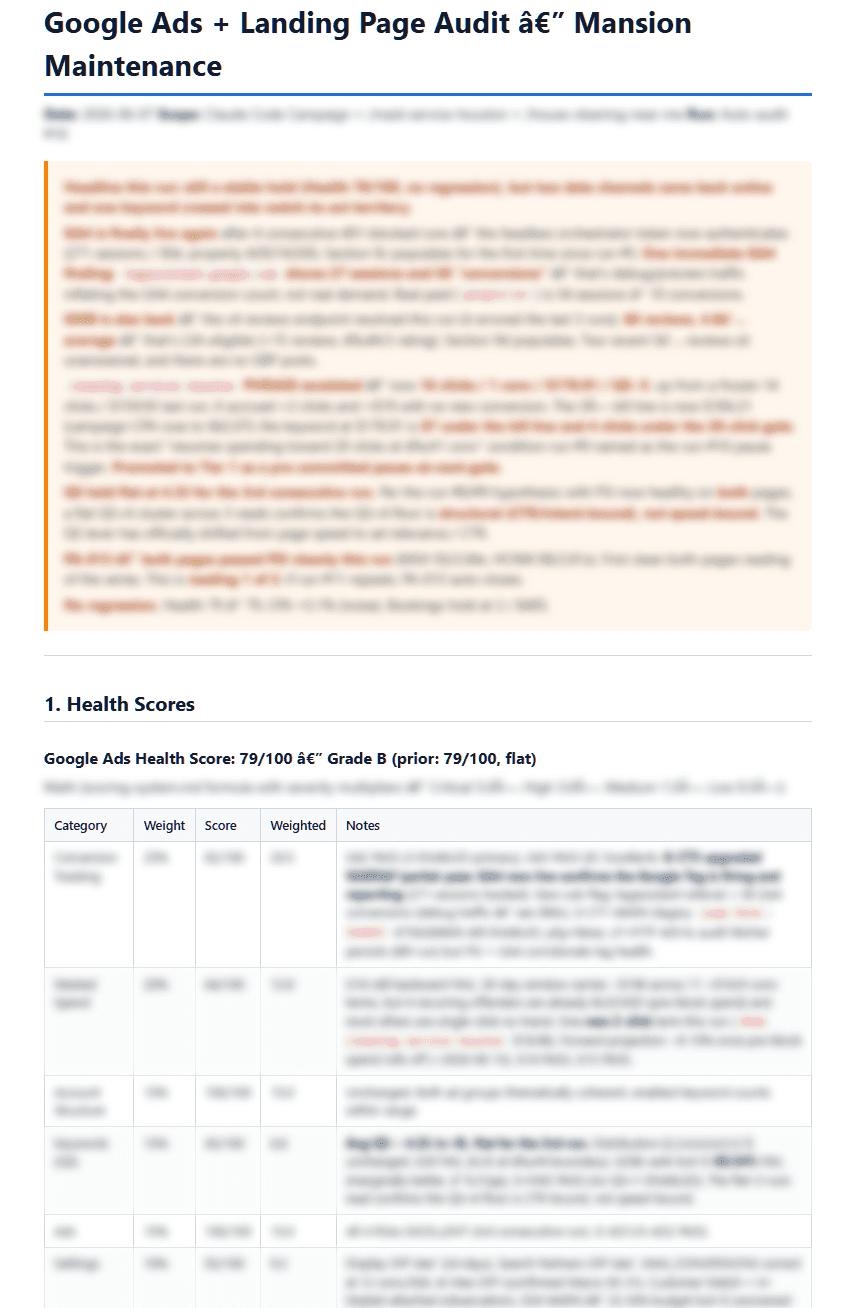
google ads audit · runs daily at noon · real
The daily Google Ads audit report the system generates, with figures redacted
The actual daily ad audit — health scores and findings, figures redacted.

The results

From the logs.

Verified by pulling actual message timestamps and run logs. We’ll screen-share the live system on any call.

3–19s

response time to a new lead — measured across every source, any hour of the day

0+

automated contact checks since April — every 2 hours plus a daily deep sweep

$0

in undeposited payments caught by a single Monday finance brief

3–10

items per day that reach a human — the rest handled or closed autonomously

A quiet, well-run office

The same stack most service businesses run — watched end to end

Four real incidents

What “watched” actually means.

The day-of save

Saved, then doubled

A cleaner went unreachable the morning of a move-in clean. The system caught it day-of, ran a replacement search across five cleaners, locked one in for the next morning, updated the CRM, and alerted the owner — before he knew anything was wrong. On-site conditions turned out far worse than scoped; the job was renegotiated and completed at double the value. A booking that would have silently died, saved.

The deep dig

The 59-day invoice

The daily deep sweep went through old phone history and found an invoice 59 days outstanding — plus an unresolved complaint — that no human was tracking. Flagged, queued, and on the owner’s phone the same morning.

The drip police

The thread that “looked handled”

A lead replied with a price objection — and 42 seconds later a dumb CRM drip fired, so the thread looked answered. The system checks whether a human actually replied to the last inbound message. It caught its own CRM lying and routed the objection to a person.

Nothing is just lost

The September callback

A lead clarified her real scope, then declined on affordability. Instead of closed-lost, the system classified it as a soft decline, emailed staff a recommended right-sized quote, and queued a quarterly check-in for September. Every lead gets a disposition.

The part nobody else shows you

What it refuses to do.

The hard part of putting AI near your customers isn’t making it act — it’s making it know when not to. Every sweep, the system evaluates dozens of possible messages and blocks most of them. It even audits itself: twice it found blind spots in its own monitoring, proved them with tests, and was hardened the same day.

Cooldown windows

Nobody gets messaged twice because two automations overlapped.

Complaint holds

An unhappy customer is a human conversation, full stop. Do-not-contact and opt-out checks run before every single send.

Quiet hours

No late-night or Sunday messages. Glowing feedback gets a personal human reply, never an automated one.

Everything logged

Every action reported — the system is auditable the same way we’d audit your books.

Your operation has the same leaks.

Fifteen minutes, screen-share, this exact system processing real work — the kind of result Modus installs for clients. Then decide if the free audit is worth half a day.